Have you ever seen duck eggs for sale at a farmer’s market or boutique grocery store and wondered…
What do I do with these?
Well, here’s (mostly) everything you’ll ever want to know about duck eggs.
- What are duck eggs?
- Where do I find duck eggs?
- What do duck eggs taste like?
- Are duck eggs different from chicken eggs?
- How long do duck eggs last?
- How do I cook duck eggs?
- A word of caution…
- Closing remarks
What are duck eggs?
Let’s state the obvious — duck eggs are eggs laid by ducks. Groundbreaking education.

A chicken, duck, and goose egg laid side-by-side on a table.
Duck eggs are slightly larger than chicken eggs – conventional wisdom says 2 duck eggs = 3 chickens eggs. But there’s a LOT of wiggle room with that number. There’s a lot of variance in duck egg size (just like chicken eggs – if you’re ever curious just go open a carton of “medium” eggs at the store and compare them to “extra large” ones. You’ll see what I mean).
Duck eggs can come in many colors – white, grey, light green, brown, blue, black, speckled… That’s because the color of the egg shell depends on the breed of the bird laying it. The color of shell doesn’t really impact the flavor of the egg itself. The color of the yolk definitely does though, which we’ll discuss later.
Duck eggs can last MUCH longer than chicken eggs when properly stored (which is generally in a fridge). We’ll discuss how to check if a duck egg is still good later.
Where do I find duck eggs?
Unlike chicken eggs, which are available at pretty much any grocery store in a wide assortment of varieties, duck eggs are a bit more tricky to find.
Since duck eggs are a bit of a rarity here in the states, you may need to go searching for them the first time around.
Boutique grocery stores can have them, as well as animal/meat vendors at your local Farmer’s Market. I’d suggest asking around at the market. I personally get my duck eggs from a lamb farmer at the PSU Farmer’s Market. The co-op down the road from me theoretically has them too, but they’re more often than not sold out.
Duck eggs are generally harder to find than chicken eggs for 2 main reasons…
ducks lay fewer eggs
Ducks lay eggs fairly regularly, with the frequency depending on the breed. Some may lay almost every day. Others once or twice a week max. Unlike geese, who only lay eggs in the spring (a product of their migratory habits), ducks can more-or-less lay eggs all year long. But – fun fact – ducks (and chickens, for that matter) need a certain number of “light hours” to produce an egg. That means during the fall and winter, when light is dwindling and nights are longer, ducks lay fewer eggs. Some breeds may stop entirely during the winter. Others do *okay* at laying in the winter (they’ve been bred to need fewer light hours to produce an egg).
Chickens also need a certain number of sunlight hours to lay, but have been bred over the years to be egg-laying MACHINES. Chickens can be tricked into laying year-round by adding lights to coops to emulate summer sunshine.
At the end of the day, statistics on breeds show us that an INCREDIBLY productive duck can around 300 days a year. But its chicken counterpart can lay 350+.
In summary, ducks lay fewer eggs and less regularly, so they’re harder to find.
ducks are harder to factory farm
I’ve raised chickens for several years and can say one thing – they’re pretty easy. All you need is a coop, space for them to range, food and water for them to drink.
This is one of the reasons we chose to factory farm chicken eggs – they’re relatively easy-to-care-for birds who lay a lot of eggs.
Ducks are another story.
Ducks are water birds. They need CONSTANT access to water to stay healthy and clean. That means they are a mess to keep. You can’t shove them into cages. And you can’t shove those cages into a tiny factory building. So it’s harder to produce duck eggs cheaply.

Which means duck eggs are mostly laid on smaller-scale, family farms. And harder to find.
What do duck eggs taste like?
In short, like a very rich and extra-fatty chicken egg.
In case you didn’t know this, the color and taste of an egg’s yolk is almost entirely dependent on what the bird eats. That’s why lots of cheap, bulk-bought chicken egg yolks have a pale-yellow yolk, while backyard or pasture-raised eggs have dark, orangey yolks.
And it’s not just color. The flavor of an egg yolk (and therefore egg entirely, since egg whites don’t have really any flavor) is dependent on the diet of the bird that laid it.
Factory-farmed chickens are fed a pelleted meal that provides them with the main nutrients they need for survival but not much else. Pasture raised birds (or backyard hens that are allowed time to free range) eat pellets, sure, but also grass, leaves, berries, bugs… pretty much anything they can get their beaks on. This means they are consuming a much wider variety of micronutrients. And that translates into additional flavor in their yolks.
If you’ve never done so before, go eat a “nice” egg. It’s a whole new world flavor-wise. Some people think the yolks taste more “grassy” or “rich”.
Follow me for a minute – think about strawberries. Have you ever an unripe strawberry? It tastes fine, but doesn’t compare to a red, ripe strawberry. The ripe strawberry is what a strawberry is supposed to taste like.
It’s the same with eggs. Most of us are just used to underwhelming eggs with essentially no flavor notes. But eggs produced by birds getting a complex, varied diet just taste more “eggy.”
So why did I go on a spiel about pasture-raised chicken eggs? Because a pasture-raised chicken egg tastes A LOT like a normal duck egg.
Like I noted before, it’s almost impossible to commercially farm ducks for eggs, so whenever you find duck eggs for sale, it’s almost certain they’ve been raised on a small farm. Small farms generally keep birds free range, which means they’ll have a varied, complex diet just like pasture-raised chickens. The yolks are darker than conventional chicken eggs. They taste more “eggy”.
I personally find that if you eat pasture raised chicken eggs on the regular, duck eggs don’t taste too different. They’re like chicken eggs in a new font. But if you’ve only really eaten bulk, cheap chicken eggs… duck eggs are going to taste VERY new.
Are duck eggs different from chicken eggs?
In a word – yes.
In more words…
Ducks and chickens, while both birds, are very different kinds of birds. In addition to differences in laying frequency, as mentioned above, the differing habitats of the birds mean they lay different eggs.
Ducks are water birds. This means they need to lay eggs that can handle more water exposure than chickens. As a result, their eggs are thicker, sturdier, and (for our intents and purposes) much harder to crack. The membrane on a duck egg holds the shell together more tightly, so don’t be surprised if it takes you a few additional tries to crack your first duck egg.
Here’s a table outlining some of the key differences in the two types of eggs…
| Chicken Eggs | Duck Eggs | |
|---|---|---|
| Size | about 2.5 oz | about 3.5 oz |
| Yolk Percent | 32% of egg | 34% of egg |
| Fat | 7% of total weight | 9% of total weight |
| Whites | tighter texture | “runnier” texture |
| Shells | more fragile, with thin membrane | harder to crack, with thick membrane |
The biggest things I’ll highlight from the above table are the differences in yolk and white. Duck eggs aren’t just “big chicken eggs.” The yolk is proportionally larger and more fatty, which means they taste richer. And the proteins in the whites are less “structured”, which means they seem more runny.
Practically speaking, this all means the yolks will be extra nice when you cook duck eggs, but the whites can be almost “rubbery” in texture when cooked on their own. I’ve also heard (but admittedly not tested for myself) that it’s hard to make fluffy whipped duck-egg whites the way you can with chicken eggs. So maybe don’t hunt down duck eggs for your next pavlova.
How long do duck eggs last?
Unless you are a SLOW egg eater, eggs in general are the sort of thing that will rarely go bad on you, especially if fresh bought.
Eggs are made of four main parts – shell on the outside, and internally white, yolk and a little air bubble. While egg shells seem pretty solid, they’re actually porous. Over time some of the water in the white will evaporate, making that air pocket larger. And bacteria will slowly find it’s way into the egg. That means that as eggs age two things happen – they get lighter and they go bad.
If you’ve never cracked a rotten egg, consider yourself very lucky. The smell and sight will stick with you. It’s pungent, sulfuric, and the white’s discoloring is pretty gnarly. Plus, cracking a rotten egg into an in-process recipe will destroy everything in the bowl.
Chicken eggs can last about a month in the fridge before they spoil. Because of their thicker shell and membrane, duck eggs can last up to FOUR MONTHS (yet another reason snagging a dozen is a safe bet – you have plenty of time to figure out how to use them).
If you’re a little too cautious to trust a several-months-old egg to be good, there’s an easy way to check without ever cracking it.
Checking if an egg has gone bad
There’s an old trick to tell if an egg has gone bad – the float test.

A freshly laid egg has an air pocket that’s only about 2.5% of its total volume. For a chicken egg, by day 42 (incidentally, about when eggs often go bad) evaporation has raised that up to 24%.
What does that mean practically? Older eggs are more full of air. And more likely to float. And more likely to have gone bad.
Here’s how to check if your egg has (likely) gone bad…
- Fill a tall dish with enough water to stand an egg in upright
- Carefully place the egg in the bottom of the full dish
- The egg will either…
- sink / stay at the bottom – This is good! The air pocket is small and the egg is fairly fresh
- stand up on it’s end – This is questionable… The air pocket is getting larger and it means the egg is getting older. It might still be good to use, but use caution
- float – Your egg is old. It’s probably not good to use any more and should be disposed of (preferably somewhere it won’t accidentally crack and stink up your kitchen)
As a general best-practice, regardless of egg test results, you should always crack eggs into a separate dish instead of directly into a recipe you’re cooking. It’s better safe than sorry when it comes to throwing out a whole batch of something.
How do I cook duck eggs?
Okay, now that we’ve gone over what duck eggs are, what they taste like, how they differ from chicken eggs… let’s get to the real question…
how do I cook duck eggs?
Honestly, pretty much however you would cook chicken eggs. Let’s break it down into a few categories…
simple – fried or hardboiled
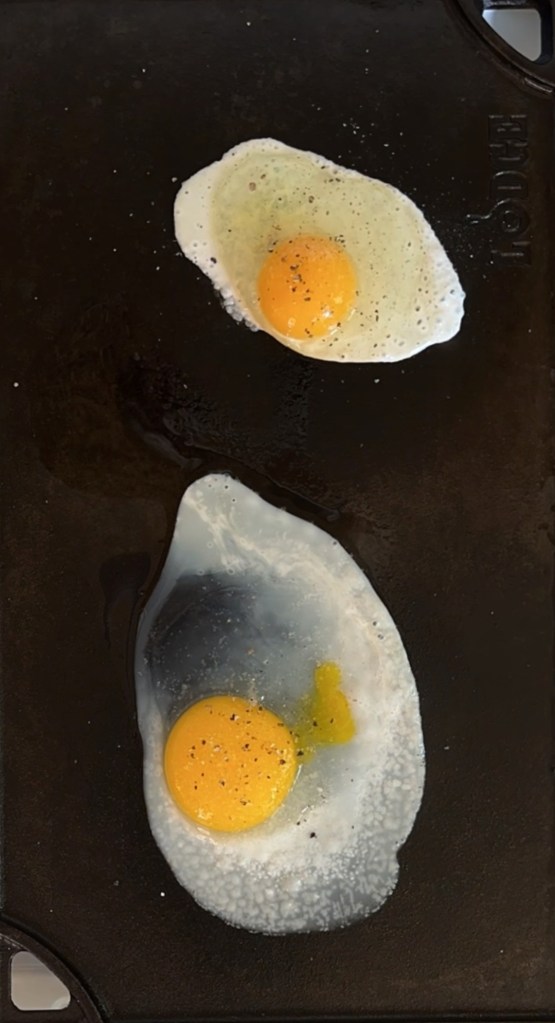
You can fry or hard boil a duck egg just like a chicken egg.
If you happen to buy a dozen duck eggs, go ahead and fry and eat at least one first thing. It’ll help you understand and form your own opinion on their taste / texture.
Like I mentioned before, the whites of a duck egg are pretty different than a chicken egg, and you’ll definitely notice the texture difference in this simple preparation.
The time to cook will also be longer – duck eggs are generally bigger. So don’t follow a “boil a chicken egg for this long to get a perfect yolk” diagram. It’ll be off.
Cook times I’ve found online vary from 7 to 12 minutes (a HUGE range) to get a perfect hard-boiled egg, so maybe do a few tests before boiling a whole dozen. If I ever get around to testing for myself, I’ll come back and update this blog.
moderate – substitute for chicken eggs in a recipe
So you’ve fried and tasted a duck egg, but now you want to do more? Go ahead and substitute them for chicken eggs in one of your go-to recipes!
Despite having more fat in the yolk and “waterier” whites than chicken eggs, they’re still eggs.
If you like omelets, try substituting duck eggs in the egg mix. As you can see in the video, once you’ve blended them up, your duck eggs and chicken eggs will be pretty much indistinguishable.
When you add in meats, veggies, and cheeses to an omelet, you’ll likely find that the flavor of the duck eggs has become less noticeable. My husband – our family’s resident omelet expert – tells me he finds duck egg omelets hold together better than chicken egg ones. But the yolk and whites take a bit longer to mix together.
Some people swear that duck eggs are the GOAT when it comes to baked goods. I don’t cook many sweets, but I could totally see that being true. As we’ve discussed, that extra fatty yolk means a richer taste.
So try out duck eggs in a baking recipe. But, if you can, use a scale to weigh out your eggs. Like we’ve said, duck eggs CAN be bigger than chicken eggs, but not always. And you CAN sub 2 duck eggs for 3 chicken eggs, but not always. Since baking relies on precise measurements for chemical reactions to occur, go the extra step if you can.
advanced – find recipes where duck eggs SHINE
So this is where my bias comes in, and I’ll 100% own it.
When I am lucky enough to snag a carton of duck eggs at the farmer’s market, I generally plan to use the dozen as follows…
| 2-4 | fried for breakfast, maybe on toast? |
| 2 | omelet for dinner |
| 6+ | DUCK EGG PASTA |
Duck egg pasta.
This is the best use of duck eggs, in my humble opinion.
For so many reasons.
I’ll go into detail on three…
Firstly, most pasta recipes call for SO MANY egg yolks. Well, duck egg yolks are bigger than chicken egg yolks. That means less separating eggs, which in my opinion is always tedious and stressful.
Secondly, the role of the fat from the egg yolk is to enrich the pasta dough – give it a tender, silky texture. Duck eggs, per gram, contain 2% more fat than their chicken counterparts. That may seem subtle, but remember that the difference between low-fat milk and whole milk is only 2% fat. That 2% makes a big difference in taste.
Thirdly, duck eggs have a lower water content ratio than chicken eggs. This comes in key when adding whole eggs to pasta dough.
There’s a bit of a debate when it comes to egg-enriched pasta dough on what to add. Some (like Missy Robbins, whose cookbook on pasta is one of my top two cookbooks of all time), argue that an egg pasta should ONLY have yolks. Others argue that adding whole eggs is important – the proteins in the white of the egg provide stability and help make rolling out the dough easier. Plus, it doesn’t leave you with jars of egg whites leftover.
This is where duck eggs become a sneaky win – when you substitute whole duck eggs for chicken eggs (by volume) in a recipe, you are adding more fat and less water. You add strength but still hold onto the tenderness by adding less water / more fat.
And as a bonus, the gorgeous color of duck egg yolks makes the prettiest pasta.
Now I’ll be the first to acknowledge that making pasta from scratch is a LOT of work. You need to make the dough, let it rest, roll it out (whether by hand or machine) and then cut and let it dry a bit before even cooking.
But… if you enjoy the process (and liked playing with Playdough as a kid), it’s so worth it.
Fresh pasta is its own thing. And so much better than the dried, shelf-stable variety.
Plus, if you have kids/friends that want to help you cook, it’s a fun activity to do communally.
In case you’re wondering, I use this pasta dough recipe whenever I make homemade pasta. I (no surprise) love the educational context of this recipe and find that it hits the perfect balance of strong and tender when it comes to texture.
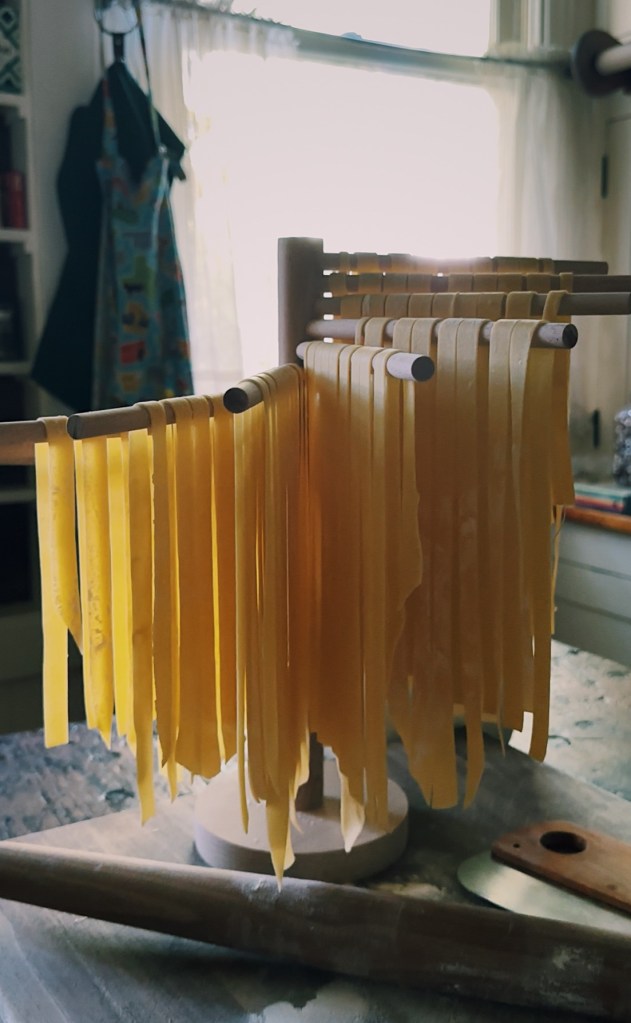
Once you’ve made the dough, it’s totally up to you what to do with it. I’ve used it for ravioli, angel hair, cavatelli… but mostly I just run it through my fettuccine cutter on my stand mixer and add it to a carbonara.
Carbonara, which is a bacon and parmesan pasta dish, utilizes whisked eggs tempered in fat to create a “creamy” sauce with no cream. If you use duck eggs here, you’ll end up with a meal that’s a true celebration of the ingredient – they’re in the pasta AND the sauce.
There are a million carbonara recipes out there — this one is my go to.
Just remember (if it’s your first time making a fresh pasta) that fresh pasta cooks way faster than dried pasta.
A word of caution…
In case you weren’t aware, eggs are considered one of the top 8 allergens. Specifically, several of the proteins in chicken egg whites are common allergens. When the white is totally cooked through (for example, when the egg is baked into a pastry) many people are able to still eat the egg, but this really is a case-by-case basis.
Duck eggs, like we’ve said already, are similar to, but different, from chicken eggs. They share several of the same proteins in their whites, namely two major allergens – ovalbumin and ovomucoid. That means if you’re allergic to chicken eggs, you may likely be allergic to duck eggs too.
HOWEVER…
Duck eggs have several unique proteins that people can be allergic or intolerant to, distinct from those found in chicken eggs.
This means some people who cannot eat chicken eggs CAN eat duck eggs.
And some people who can eat chicken eggs CANNOT eat duck eggs.
Before this causes you to panic and cry out in outrage, take a deep breath. This intolerance / allergy is relatively rare (although, like egg allergies in general, more common in children than adults).
This just means (as is a good practice in general when trying a new food that is a relatively common allergen) try a small amount your first time around. And maybe give friends a heads up before serving them duck eggs, just in case.
Closing remarks
Duck eggs are one of my favorite “unusual” ingredients. They save well, can be used for a wide variety of purposes, and are just fun to have.
While a little more pricey than normal eggs, they’re not a crazy splurge like fancy mushrooms or a super-nice steak. But they bring drama to ordinary dishes. You can cover two pieces of toast in a single egg, serve up deviled eggs as big as your hand, or cover a whole (personal) pizza with one egg.
I hope this has inspired you to grab a dozen for the first time. Or start adding them to your regular rotation.
Because food should be fun. And a little ridiculous – like duck eggs.
Do you like educational food content, but prefer a video format? Check out the video form of this blog on our socials…


 Cara Can Cook
Leave a comment