In the world of polarizing ingredients, there is one that reigns supreme…
Anchovies
You might love them, or perhaps you hate them – but opinions about anchovies are rarely moderate.
Well, I’m gonna teach you a secret today, friend: even if you think you hate these little fish, you actually do love anchovies. You just don’t realize it.
What are anchovies?
Anchovies are small, saltwater fish that are extremely common worldwide.
Anchovies are considered an “oily fish,” which means they have fat distributed all throughout their soft tissues (in contrast to “whitefish”, which only have oils in their livers). There are many varieties of oily fish, from sardines, to salmon, to tuna. This oil can be up to 30% of their body weight, and is what causes them to be so dense in omega-3 fatty acids, an essential nutrient for humans that we can’t produce on our own.
While humans certainly consume a lot of anchovies around the world, they are also an essential part of the subnautical food-chain. It is a significant food source to a wide number of predatory fish, including, but not limited to: halibut; rockfish; shark; and salmon. Their abundance also makes them a common bait for fishers; in fact, for several species they are considered a top bait.
What do anchovies taste like?
You may not know this, but freshly-caught and cooked anchovies have a relatively mild flavor. They’re still “fishy” due to their high oil content, but much more similar in flavor profile to a salmon or sardine.
The salty, funky, umami flavor we associate with anchovies actually comes from the way most are processed: cured in salt, and then soaked in olive oil. This salt-curing “cooks” the fish and prevents bacterial growth, effectively making tinned anchovies shelf-stable indefinitely.
umami
In case you haven’t heard the term before, umami is one of the five flavors (along with salty, sour, sweet, and bitter). Many people associate this flavor with things being “savory” or “meaty”, but it’s more than that. It’s the sensation of mouthwatering. Umami flavor is…
- Drizzling worcestershire sauce to a steak
- Dumping a can of cream of mushroom soup to a green bean casserole
- The savory element of a bright, fresh tomato
- That rich flavor you taste in fermented foods like kimchi, miso, or even aged parmesan cheese
It’s a hard flavor to describe abstractly, in the same way that it’s hard to describe what “salty” is if you haven’t learned it in context. But there are specific taste receptors on your tongue that are designed to pick up umami, and our brain wants to taste it in food. Once you get it, you’ll never forget it.
How long do they last?
I often go hyper-seasonal and fleeting in my recipe deep dives – but not today. In fact, anchovies are kind of the opposite of “hyper-seasonal.” You will find anchovies in almost every grocery store (for a really good price, to boot)… and once you buy some, they can live in your pantry forever – no need to plan ahead.
When bought canned in olive oil (which is likely how you’ll find them), anchovies are shelf-stable almost indefinitely. Like most canned goods, the recommendation is to consume them within 2 years, but if the can isn’t dented, punctured, or rusted… they’re probably still good 20 years later. When properly sealed, canned goods have no exposure to external bacteria / contaminants and simply don’t go bad.
Once opened, you can store a tin of anchovies in the fridge for up to 2 months, as long as they are still entirely covered in oil. So if you only want an anchovy or two at a time, this is great news – opening a tin is not an all-or-nothing proposition like it is with some other canned or tinned goods.
A universally loved ingredient
Anchovies are fished and processed for human consumption across many different cultures and cuisines, including…
- Japanese cuisine: Iriko – dried and used as an essential ingredient in dashi
- Korean cuisine: Myeolchi-jeot – salted and fermented, used as an ingredient in kimchi
- Vietnamese cuisine: Nuoc Mam – anchovies are one of the primary ingredients in fish sauce
- Southern Indian cuisine: Netholi – served dried or fresh (often fried or in a spicy curry)
- Turkish cuisine: Hamsi – commonly eaten in the winter, often fried, grilled or steamed
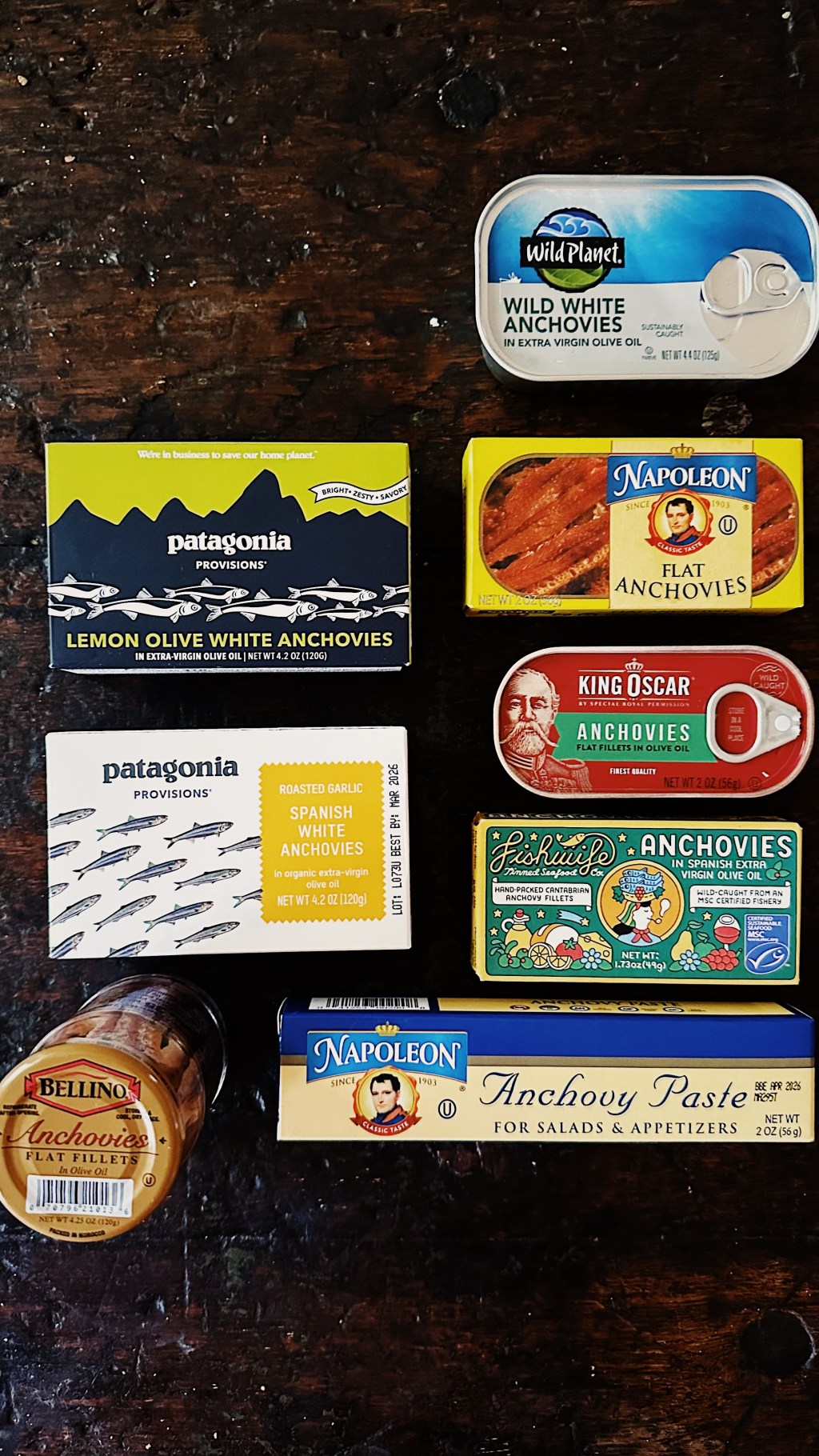
In the west, we find anchovies in 3 main forms. Unfortunately, in English all three of these forms have the same name, so I will use the Spanish names here to help distinguish.
| Cured in Salt and Tinned in Oil (“anchoa”) | This is BY AND FAR the most common way to find anchovies. Very soon after being caught, these anchovies are placed into salt to cure for 3 to 12 months. After that time, they are washed and carefully have the bones and scales removed. This is the point in their processing where the flesh of the fish has become the grey we normally associate with anchovies. To preserve them even further, they are now submerged in olive oil and stored in either cans or jars. If you ever want a good read about how anchoa anchovies are processed and turned into their tinned final form, check out this blog from an anchovy processor. |
| Marinated in Vinegar (“boquerones”) | This is the second-most rare way to find anchovies. Anchovies can be cleaned, filleted, and marinated in a weak vinegar sauce to make the boquerone varietal. And while you’ll find a uniquely not-fishy taste with boquerones, they do age much more quickly than anchoa anchovies, so you’ll need to refrigerate them and consume them relatively quickly after cracking open a tin. Boquerones are not cured in salt, so the fillets stay tender and white, and do not develop the strong, salty/fishy taste and smell most people associate with anchovies. In the US, you’ll often see these labeled as “white anchovies” since the fillets do not discolor from salt exposure. |
| Fresh (“bocarte”) | This is the least common way to find anchovies, especially in the US. Why? Well, anchovies are small, delicate, and (due to their high oil content) spoil quickly. You need to cook them pretty much immediately after catching them. Due to this, most fishmongers in the US won’t carry them. More often than not, anchovies are caught and processed within 24 hours. |

The final form of anchovy I’ll note? Anchovy paste.
Due to its popularity as a sauce ingredient, many manufacturers will grind anchovies that have already been salt-cured with additional olive oil (and other flavor additives) to create anchovy paste. Its smooth texture makes it easy to incorporate into sauces, although I’ll explain later how to make this paste easily at home – without paying the paste-processing upcharge that food manufacturers will levy on you, and without sacrificing control over how many or which flavor additives you’d like to include.
A secret Ingredient
When anchovies are cured in salt and stored in oil, they transform into one of the most powerful umami flavor sources out there. This is why anchovies play such an incredibly important role in making a savory sauce.
Fish sauce. Worcestershire sauce. Puttanesca sauce. Remoulade. Green Goddess Dressing. CAESAR.
What do all of these have in common?
Anchovies.
When you are making a sauce and want to make it saltier, you add salt or maybe miso / soy sauce. If you want the sauce to be more sour and acidic, add lemon juice. Sweet? Add sugar.
But what about umami? If you want to make a sauce more savory, deep… you add anchovy paste.
This is what I’ve been alluding to from the beginning. You have probably been eating some form of anchovies for years. If you loved how worcestershire made steaks and chex mix more rich and satisfying… yep, that was the anchovies. If you loved the hearty, filling tang of caesar dressing on a salad or wrap… also anchovies. If you felt like green goddess dressing on your grain bowl made it somehow more filling, richer, “meatier”… anchovies again.
All anchovy skeptics may now take a minute to process this information.
And now, if you’re a newly-open minded anchovy skeptic, let’s go ahead and talk about how to use the anchovy’s umami-superpower to make incredibly delicious meals.
How to cook them
Let’s start out by saying that this section may be a little different than my other blogs. Because, yes, I do want you to learn how to cook with anchovies so you can see and taste them. BUT… I also want you to learn how to make them your ultimate umami-flavor secret agent, in a way that would leave your dinner company shocked that they were even there to begin with..
That’s the secret of anchovies – sometimes, they are front and center as the star of a meal. But more often than not, they are the unrecognized-yet-pivotal ingredient in the background that turns your meal from “pretty good” to “out of this world.”
But let’s start with the basics: how to enjoy eating anchovies front and center.
Making anchovies the focus
When you are eating anchovies as is, without mashing them up or working them into a sauce, the quality of the anchovy is super important. This is where the three forms of processing we mentioned above come into play.
White anchovies, as I said before, are anchovies that have been mildly marinated but not cured in salt. They are much milder in flavor and sweet, without that punchy, salty kick.
This is a good place to start with eating anchovies.
An anchovy toast, part 1
If you want to give yourself the best possible first taste of anchovy (or if you already love them and want a delicious snack with an afternoon tea), here’s what to do…
Get a nice, crusty bread and slice it thin.
Heat some olive oil in a pan over medium heat, then firmly press the bread into the oiled pan. Toast both sides till they’re evenly crispy and salty. In our house we call these “toasties,” and they are deeply beloved. You may be tempted to use your toaster. Don’t. The bread won’t achieve the same deep saturation of oil and smooth crisp edge.
Now take some softened, salted butter and generously spread it on your toastie.
Finally, top it all with a juicy, perfectly sized white anchovy (boquerone). In my version here, I’ve added a few pickled spring onions for a nice, sour crunch.
This is the right way to enjoy an anchovy.

Letting anchovies enhance a dish
Now we move to more subtle means – incorporating anchovies into other things in a way that doesn’t overpower, but rather enhances.
In order to do this, though, we need to discuss something…
The magical, melting anchovy
I will forever be grateful to Justine Doiron for teaching me one thing: you can melt anchovies using just heat and patience.
As we’ve said before, anchovies are an INCREDIBLY oil fish that is brined and then stored in more oil. That curing process almost completely breaks down the protein fibers found in their muscles. So when the oil is heated, the last bit of stability goes out the window.
Literally all it takes is a tiny bit of work and the anchovy fillets will disintegrate into the oil.
The steps are pretty simple…
- open a tin of anchovy fillets (this is important – whole anchovies will take much more work to break down)
- place all contents of tin into a small pan over medium low heat
- let the oil come to a soft, bubbly simmer
- take a spatula and mash the anchovies – with a minute or two of work the fillets should entirely dissolve into the oil
Let this enriched oil cool down and then add it to anything you want to give an umami boost.
Here are some of my favorite examples…
Compound butter
If you’ve never made a compound butter before, you should.
It’s remarkably simple – you just soften a stick (or several) of butter and then mix it with some sort of flavor boosting ingredient. Then put it back in your fridge and use whenever you’d like.
A classic compound butter is just herbs and garlic. Or maybe a sweet choice, like cinnamon and honey (which is INCREDIBLY good on a fresh pancake). But I’m here to tell you the best option – anchovy compound butter.
Go ahead and melt your anchovies in a pan, as discussed above. If you’d like, add a pressed garlic clove after they’re dissolved and then immediately turn the heat off (I find with garlic you want to cook it a little, but not too much. Burned garlic ruins any dish it’s in). Once the anchovies are cooled, mix them into your softened butter. And you’re done.
There are so many uses for anchovy butter. I love putting it on steaks while they’re cooking on the flat top (basting a steak in butter is a GOAT-ed method). To be clear, you don’t taste fish. It just adds salt and that UMAMI factor we discussed earlier.
But you don’t need an expensive steak to enjoy anchovy compound butter. I find it makes the PERFECT brunch, so let’s revisit a concept from earlier…
An anchovy toast, part 2
Anchovies and butter and on toast is a french classic.
But let’s make it so only you know there’s anchovies.
Get another crisp slice of toast and slather it up in anchovy butter. I like to add heirloom tomatoes (they’re the best produce in summer, IMO), an egg and pickled onions.
It’s so simple. And it is – I’m serious – the best toast I’ve ever had.
And again, you don’t taste fish! It is salt, rich, satisfying in a way you can’t quite put your finger on… (SPOILER ALERT – it’s anchovies).
Making a salad dressing
There are countless classic sauces that utilize anchovies for a rich, umami component. Notably, so many salad dressings.
I’m gonna rant for a minute…
If you want to up your salad game, you need to start making your own dressings. This is probably one of the most significant changes I have personally made in the last few years, re: cooking.
Salad dressings are fundamentally an emulsion of fat and water, generally in the form of some sort of oil and vinegar. Emulsions, the uniform distribution of small particles of hydrophobic fat in water, are by their very nature unstable. Aka – oil and water don’t mix and won’t stay blended without SERIOUS persuasion. So that means shelf-stable salad dressings inherently have a problem. You know that any bottle of vinaigrette you buy will be separated. You’ll need to shake it and it won’t really blend. Same thing for creamy dressings, although the separation isn’t as noticeable. To fix this, many store bought dressings have a TON of additives to stabilize the mix. Which often detract from the final taste.
It is wildly easy to make a salad dressing at home. It can be as simple as putting oil, balsamic vinegar, and a little mustard (your stabilizer) into a mason jar and shaking it. Or as fancy as using an immersion blender / food processor to whip up a full batch.
You can – and should – make a great homemade Caesar dressing at home. Anchovies will give it a deep flavor that will make you think you’re eating a restaurant-grade salad. I’m not going add another Caesar recipe to the internet – use Brian Lagerstrom’s. It’s the best.
I will mention my favorite anchovy-based dressing. It’s something I came up with a few years ago on my own, and at this point I literally make a jar a week to keep in the fridge. It’s my 3 year old’s favorite sauce and you should try it to. We just call it…
Anchovy sauce
Ingredients:
- 1/2 cup full-fat yogurt
- 1/4 cup finely chopped fresh parsley
- 2 tbsp lemon juice
- 2-3 cloves of garlic, pressed
- 1 tin anchovy fillets, in oil
- salt and pepper to taste
Dissolve the anchovies in a pan. Right before turning off the heat, add your pressed garlic. Let this cool.
In a bowl, combine the yogurt, lemon juice, and parsley. Add the anchovy and garlic oil and stir to combine.
Salt and pepper to taste.
What does it taste like? I think it’s the perfect hybrid of a ranch and Caesar. It has the deep, rich, salty anchovy flavor signature to Caesar, but the bright yogurt and herbs of ranch.
We use it on salads, veggies, and pan seared salmon. Try it.
The positive impact of tinned fish
Up until this point, everything I have mentioned about anchovies has been centered on their taste and role in creating wonderful, balanced dishes. This is because I love anchovies. I truly believe that, on merit of taste alone, they should be a staple in your pantry.
But besides being delicious, anchovies are also good for both the planet and your pocketbook.
If fished responsibly (a big “if” here), anchovies are more climate-friendly than almost any other fish. They raise themselves in the wild and don’t need to be farmed. They live at the bottom of the food chain and can be replenished faster. They don’t need to be caught with drag nets. And little fish like anchovies are one of the lowest foods in the world in carbon-emission-production.
In terms of price, anchovies are considered one of the healthiest and cheapest sources of protein out there. They are high in omega-3 fatty acids, which despite being essential for our body’s function, are not produced by the human body and therefore must be consumed. Interestingly, there is also some limited evidence that omega-3 fatty acids may be useful in Alzheimer’s prevention.
To sum it up… they’re cheap. They’re good for you. They’re low-impact on our earth. And they’re really delicious.
In closing
I know some of you started this read already loving anchovies. And I know for others, this was a hard sell from the start. If that’s you, that’s okay. Anchovies are synonymous with “funky food” in our society.
But even if you’re not a convert to Team Anchovy, I hope you now know that they’re so much more than a little salty fish. They’re umami bombs, just waiting to take your cooking game to a whole new level.
And I hope you use them.
Just remember, with great power comes great responsibility. Anchovy away, friends.
Do you like educational food content, but prefer a video format? Check out the video form of this blog on our socials…


 Cara Can Cook
Leave a reply to Cara Dooley Cancel reply